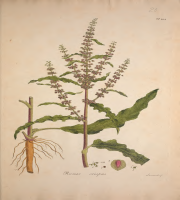
(Greek dock)
Botanical info:
Greek dock is a perennial herb perennial, glabrous, with fusiform, vertical rootstock. Stems erect, branched from above growing from 70 to 150 cm tall. It grows naturally in abandoned fields, roadsides, and fallow grounds. It is native to the south Balkans and Turkey. Flowering from May to August.
Hippocratic legacy:
a. In Affections:
a. Greek dock is described as hydrating laxative.
b. In Regimen 2:
a. Greek dock is described as heating laxative.
c. In Regimen in Acute Diseases (Appendix):
a. Greek dock leaves are recommended in cases of weakness.
d. In Diseases of Women 2:
a. The root of Greek dock is recommended as a dermatological remedy.
Other uses:
The Greek dock root has laxative, alterative and mildly tonic action, and can be freely used as a tonic and laxative in rheumatism, bilious complaints and as an astringent in piles, bleedings of the lungs, etc. It is indicated for diseases of the blood, from a spring eruption, to scurvy, scrofula and chronic skin diseases. It is also useful in jaundice and as a tonic to the stomach and the system generally. A syrup can be made by boiling crushed root in syrup, which is taken in teaspoonful doses. The infusion administered is made by pouring boiling water on the powdered root. A useful homoeopathic tincture is made from the plant before it flowers, which is of service to an irritable tickling cough of the upper air-tubes and the throat. It is likewise excellent for dispelling any obstinate itching of the skin. To be applied externally for cutaneous affections, an ointment may be made by boiling the root in vinegar until the fibre is softened and then mixing the pulp with lard. The seeds have been given with advantage in dysentery, for their astringent action.