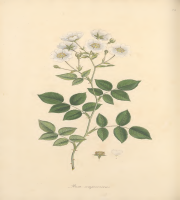
(Evergreen rose)
Botanical info:
Evergreen rose is a scrambling or prostrate evergreen shrub with stems up to 1.5 meters high, growing in hedges or forming thickets, while climbing forms can reach 3.5 m in height, bearing small, hooked, rarely straight, prickles. It grows naturally in maquis or in sheltered valleys, and forest clearings. It is native to the north Mediterranean coast and northwest Africa. Flowering from May to July, and even later in higher altitudes.
Hippocratic legacy:
a. In Ulcers:
a. Cooked evergreen rose leaves are applied as a poultice for the treatment of ulcers.
Other uses:
Rose petals are official in nearly all Pharmacopoeias. Though formerly employed for their mild astringency and tonic value, they are to-day used almost solely to impart their pleasant odour to pharmaceutical preparations. Syrup of rose is used to impart an agreeable flavour and odour to other syrups and mixtures. Honey of roses was popular for sore throats and ulcerated mouth and was made by pounding fresh petals in a small quantity of boiling water, filtering the mass and boiling the liquid with honey. Rose vinegar, a remedy for headache caused by hot sun, is prepared by steeping dried rose petals in best distilled vinegar, which should not be boiled. Cloths or linen rags are soaked in the liquid and are then applied to the head.