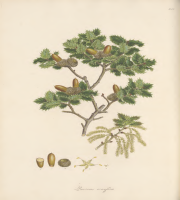
(Kermes oak)
Botanical info:
Kermes oak is a shrub less than 2 m high, rarely a small tree, reaching 1–6 m tall and 50 cm trunk diameter. It is evergreen, with spiny-serrated coriaceous leaves and inconspicuous flowers. It can survive heavy sheep and goat grazing for a long time as a ground carpet a few centimeters high and will grow higher as a bush or a tree according to how much the grazing pressure is slackened. It is native to the Mediterranean Basin.
Hippocratic legacy:
a. In Ulcers:
a. Kermes oak root is described as wound purgative.
b. The same therapeutic property is attributed to kermes oak stem.
c. And against burns.
Other uses:
This oak is the host for the kermes insect, hence the common name. Cochineal (a red dye) is extracted from the bodies of dead female kermes insects. Kermes oak as respond to infestation produces galls, which is the main medica material. Galls are much used commercially in the preparation of gallic acid and tannic acid, and are extensively employed in tanning and dyeing, in the manufacture of ink, etc. Medicinally, they are a powerful astringent, used as a tincture internally, in cases of dysentery, diarrhoea, cholera, and as an injection in gonorrhoea, leucorrhoea, etc. Preparations of gall are usually applied as a local astringent externally, mainly in Gall ointment, applied to painful hemorrhoids, and to arrest hemorrhage from the nose and gums. An infusion may be used also as a gargle in relaxed throat, inflamed tonsils, etc.