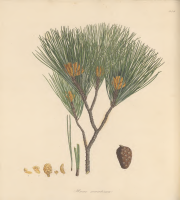
(Scots pine)
Botanical info:
The scots pine is a coniferous evergreen tree growing up to 35 m in height and 1 m trunk diameter when mature, exceptionally over 45 metres tall and 1.7 metres trunk diameter on very productive sites, The bark is thick, scaly dark grey-brown on the lower trunk, and thin, flaky and orange on the upper trunk and branches. It grows naturally in northern woodlands, steppes. It is native to Europe and Anatolia extending north to Siberia and east to Central Asia.
Hippocratic legacy:
a. In Ulcers:
a. The scots pine bark is described as softener and wound healing agent.
Other uses:
This is an important timber tree in Europe. In Scandinavian countries, the pine was used for making tar and has also been used as a source of rosin and turpentine. Tar is an impure turpentine, viscid and brown-black in color, procured from the roots of scots pine. Tar is used medicinally in veterinary practice, for its antiseptic, stimulant, diuretic, and diaphoretic action. Oil of turpentine is a good solvent for many resins, wax, fats, caoutchouc, sulphur, and phosphorus, and is largely employed in making varnish, in oil-painting, etc. Medicinally, it is much employed in both general and veterinary practice. Rosin is used not only by violinists, for rubbing their bows, but also in making sealing wax, varnish, and resinous soaps.