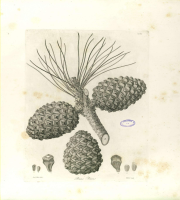
(Stone pine)
Botanical info:
The stone pine is a coniferous evergreen tree that can exceed 25 metres in height, but 12–20 m is more typical. In youth, it is a bushy globe, in mid-age an umbrella canopy on a thick trunk, and, in maturity, a broad and flat crown over 8 m in width. The bark is thick, red-brown and deeply fissured into broad vertical plates. It grows naturally in Mediterranean forests, woodlands, and scrub biome ecoregions. It is native to south Europe and Anatolia.
Hippocratic legacy:
a. In Fistulas:
a. Stone pine bark grindings is used as hemostatic in fistulas.
b. In Nature of Women is recommended:
a. As genitals fumigant.
c. In Diseases of Women 1 is used:
a. Against vulval ulcers.
d. In Diseases of Women 2 is suggested:
a. Against uterus bleeding.
Other uses:
The resin of this pine is used for varnishes, furniture wax and as an antiseptic and for kidney and bladder problems. A green dye can be made from the needles. The seeds are highly edible and sold in the market as 'pine nuts'. They can be eaten raw or roasted.
All the Pines yield resin in greater or smaller quantities, which is obtained by tapping the trees. The crude resin is almost entirely used for the distillation of oil of Turpentine and Rosin, only small quantities being employed medicinally - for ointments, plasters, etc. When the Oil of Turpentine is entirely distilled off, the residuum is Rosin or Colophony, but when only part of the oil is extracted, the viscous mass remaining is known commercially as common Crude Turpentine.