ΕΛΑΙΑ
Olea europaea
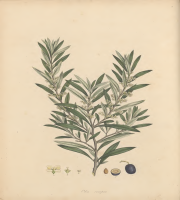
(Olive)
Botanical info:
Olive is an evergreen tree that typically grows to 6 – 9 m tall with a rounded crown. Young trees have smooth gray bark, but trunks and branches will gnarl somewhat picturesquely with age. Leaves are gray green above and silver-green beneath. It is found mostly in cultivation and its ancestry is unknown. It is considered native to the Mediterranean basin. Flowering June to July.
Hippocratic legacy:
a. In Nature of Women:
a. Olive leaves and fruits as fumigants.
b. Lecanium oleae (a parasite of olive trees) is also described against uterus deviation
b. In Diseases of Women 1:
a. Olive fruit is described to indicate the size of vulval suppositories.
c. De mulierum affectibus ii:
a. Olive leaves for the treatment of leukorrhea.
b. Olive leaves for the treatment of uterus bleeding.
c. Olive fruit for the treatment of uterus pain.
d. Lecanium oleae (a parasite of olive trees) is also described for the treatment of leukorrhea.
Other uses:
The leaves are astringent and antiseptic. Both leaves and bark have valuable febrifugal qualities. The oil is a nourishing demulcent and laxative. Externally, it relieves pruritis, the effects of stings or burns, and is a good vehicle for liniments. With alcohol it is a good hair-tonic. As a lubricant it is valuable in skin, muscular, joint, kidney and chest complaints, or abdominal chill, typhoid and scarlet fevers, plague and dropsies. Internally, it is a laxative and disperser of acids, and a mechanical antidote to irritant poisons. It is often used in enemas. It is the best fat for cooking, and a valuable article of diet for both sick and healthy of all ages.